
Our most recent road trip began innocently enough: a family gathering in Dayton, Ohio.
We have made the journey from Arkansas to Dayton more times than we can count, so we wanted to find a few new roads, roadside stops, and filming opportunities along the way. The family gathering was the primary reason for the trip, but anyone familiar with RealRoads knows we rarely travel several hundred miles without looking for another highway to document.
Once the gathering wound down, we planned to make a quick run north to Chicago. We could film Interstate 65 from Indianapolis to its northern terminus, capture a strong approach into the city, spend an afternoon exploring Chicago, and then leave the following morning by way of historic Route 66.
From there, we would make the approximately 12-hour drive home in one shot.
That was the plan, anyway.
Five People, Two Cars, and One Bad Assumption

AI Generated image of a 2026 Toyota Corolla and 2025 Toyota Camry
Because of the size of the family gathering—and the number of people traveling with us—we decided to take two vehicles.
That detail may not seem particularly important yet.
It will be.
For the trip north, we selected a route we had not previously filmed in its entirety: Interstate 64 east into Louisville, followed by Interstate 65 north from Louisville to Indianapolis. We also selected a few roadside stops to break up the drive and planned the route so the trailing car would have no difficulty keeping pace with the lead vehicle.
We were traveling with five people, including one person with limited mobility. Our assumption was that dividing everyone between two cars would result in roughly the same amount of stopping time as carrying two or three people in a single vehicle.
You can probably guess how accurate that assumption turned out to be.
The Storm Finds Us

Approaching storm in Kentucky. © The Open Road Archive
Our planned departure time was 7:00 a.m.
Shortly before leaving, however, we received a call from the family member riding with us. She was running a few minutes late.
We eventually departed at 7:40.
From our small Arkansas suburb, we followed Interstate 40 and Interstate 57 toward Walnut Ridge. Where I-57 temporarily ends, we turned east onto U.S. Route 412 through Paragould, Kennett, and Hayti.
After a brief comfort stop in Hayti, we continued onto Interstate 155 toward Dyersburg and U.S. Route 51—the developing Interstate 69 corridor.
It was around this point that we began watching the clouds gathering to our north and west. These were not the friendly, white clouds of a pleasant summer afternoon. They were growing darker, heavier, and considerably more ominous with every passing mile.
We made sure to capture the new Union City bypass northbound before the weather arrived, then settled into the Kentucky portion of the drive, which now follows Interstate 69.
We attempted to stay ahead of the storm, moving as quickly as we safely and comfortably could. Unfortunately, our longer-than-expected stops gave the weather enough time to catch us.
From south of Evansville nearly all the way to Louisville, the sky opened.
It did not merely rain. It came down in dense, wind-driven sheets that swallowed the pavement, erased the horizon, and turned every passing truck into a rolling wall of spray. The wipers worked at full speed and still struggled to clear the windshield. For mile after mile, the road existed only as a pair of faint lane markings shimmering beneath a gray curtain of water.
Remember those two vehicles?
As we approached Louisville, the rain finally began to ease. A glance at the radar suggested that the road toward Indianapolis might be relatively clear.
Then came the call nobody wants to receive while attempting to outrun a storm:
“I need to stop, walk around, and use the bathroom.”
So much for escaping the weather.
At that point, we abandoned the planned I-65 segment. Rather than continuing north through Indianapolis, we remained on the more direct route toward Cincinnati and approached Dayton from the south.
Naturally, it rained almost the entire way to Cincinnati.
By then, we had accepted that we would reach Dayton after dark—something we had specifically hoped to avoid. We made one final stop at a rest area south of Cincinnati, giving everyone a chance to recover after approximately three hours of driving through heavy rain.
We finally arrived in Dayton shortly after nightfall.
A Road Trip Within the Road Trip

AI Generated image representing the SW Ohio Triangle.
We spent approximately a week in Dayton.
We all know what happens after several days surrounded by family: eventually, everyone needs a little breathing room.
Our solution was another road trip.
The original idea was to head toward Chillicothe and visit Serpent Mound, but it was closed that day. We briefly discussed touring and filming several state parks, but ultimately chose what we called the southwestern Ohio triangle: Interstate 75 south from Dayton toward Cincinnati, Interstate 71 northeast toward Columbus, and Interstate 70 west back to Dayton.
The result was a pleasant four-hour diversion and an opportunity to film another portion of I-71.
Following this trip, the primary sections of Interstate 71 we still need are the route through Columbus and the final few miles in Cleveland beyond the Interstate 271 split.
We also filmed several local roads around Dayton during the week, although nothing on the scale of the footage now being published from the larger journey.
At this point, you may be thinking the trip does not sound particularly disastrous.
A little rain never hurt anyone. We still captured good footage, enjoyed a drive around southwestern Ohio, and reached the family gathering safely.
So where do the Griswolds enter the story?
The real adventure was only beginning.
Circling Downtown Indianapolis

Monument Circle, Indianapolis, Indiana. © The Open Road Archive
We left Dayton approximately two hours earlier than originally planned for a variety of reasons and followed Interstate 70 west toward Indianapolis.
One of our passengers wanted to visit one of the city’s stadiums or arenas long enough to take a few photographs outside.
With one car, this would have been inconvenient.
With two cars, it became a logistical nightmare.
We circled downtown repeatedly, attempting to find two nearby parking spaces close enough for our passenger to jump out and take his photographs. After roughly 20 minutes, we finally pulled briefly into a no-parking area near an active construction zone, took the photograph, and moved on.
Finding our way back to the interstate proved nearly as challenging as finding somewhere to stop. Large portions of downtown Indianapolis seemed to be under construction, with detours, closures, and temporary signs sending us in every direction except the one we wanted to travel.
Eventually, we escaped downtown, reached Interstate 65, and began heading north toward Chicago.
The Bug That Ruined a Day of Footage

The Bug Splat. © The Open Road Archive
We stopped for lunch somewhere near Lafayette, Indiana.
During that stop, our driver received some upsetting personal news. It understandably affected his mood and concentration for the next several hours.
Unfortunately, it also meant he failed to notice the massive insect splattered directly in front of the camera.
From just north of Lafayette through the remainder of the day, nearly every video contains a large bug splat in the center of the frame. It obscures a significant portion of the view and compromises what would otherwise have been excellent footage.
We have been experimenting with ways to remove it and salvage the recordings. Some early results have been encouraging, although restoring several hours of moving video is not a simple task.
Still, bad news and a bug splat are not enough to create a proper Griswold vacation.
For that, we needed a pothole.
The Pothole in Gary

AI Generated image of potholes in Gary, Indiana
Somewhere around Gary, Indiana, the following car struck a pothole.
Normally, that would barely qualify as an event. Anyone who regularly drives through northern Indiana or the southern Chicago area has probably hit worse.
This pothole, however, triggered a chain of events some members of our group were still feeling two weeks later.
Toyota builds some of the most reliable cars on the road. We own them for a reason. Even reliable cars, however, can suffer from a poorly placed piece of plastic and a remarkably unfortunate sequence of events.
When the car struck the pothole, a small clip securing the hood-support rod apparently broke. The rod began bouncing around beneath the hood as the vehicle continued over the rough pavement.
Eventually, the rod itself came loose and dropped into the engine compartment, where it struck or damaged a sensor.
Among other problems, the car could no longer reverse.
We did not yet understand the extent of the damage. In fact, we would not fully understand it until the next morning.
For the moment, we continued north on U.S. Route 41 as it became Lake Shore Drive, following the roadway to its northern end. From there, we turned south so our resident stadium enthusiast could photograph Wrigley Field.
That was where we discovered the second car had a serious problem.
A Car That Cannot Reverse at Wrigley Field

Millennium Park, with Cloud Gate, Chicago. © The Open Road Archive
Anyone who has visited Wrigley Field knows that parking can be difficult under ideal circumstances.
We were fortunate enough to locate two back-to-back spaces about a block away. The lead car pulled into its space normally.
The second car attempted to park and discovered that it could not reverse.
It was left sitting at an awkward angle while we tried to understand what had happened. Fortunately, there was enough room for traffic to squeeze past while we investigated.
During our week in Dayton, we had changed our Chicago itinerary to include dinner with a family member who lives in the city and owns a restaurant there. Since the car remained drivable in a forward direction, we continued to the hotel, checked in, and spent the remainder of the afternoon sightseeing with family before dinner.
Compared with everything else, the evening was uneventful.
We should have appreciated that while it lasted.
July Third at a Downtown Chicago Toyota Dealer

Buckingham Fountain, Chicago. © The Open Road Archive
The following morning confirmed that the car was still thoroughly foobar.
We had hoped the problem might be electronic and that the vehicle’s computer would reset overnight.
It did not.
Pushing a disabled car out of a parking space in an underground downtown Chicago garage at seven in the morning is not particularly enjoyable. Navigating rush-hour traffic to the nearest Toyota dealership—while visiting from out of town and driving a car that cannot reverse—is even less enjoyable.
Our original plan had been to leave the hotel at 7:00 a.m. and be out of Chicago by approximately 8:00 or 8:30.
Instead, we drove to Downtown Toyota.
After an initial misunderstanding with the service department, the technicians brought the car inside for an inspection. They continued diagnosing it until around noon.
Did we mention this was July 3?
The dealership eventually confirmed that the repair was covered under warranty and should be relatively straightforward.
There was only one problem: they did not have the necessary part.
Because of the Independence Day holiday, it would not arrive until the following Tuesday or Wednesday.
We now had three options:
Stay in Chicago for nearly another week.
Rent a car, drive home, then return later with both the rental and one of our own vehicles.
Or load all five people and all our luggage into a single Toyota Camry for the 12-plus-hour trip home.
Guess which option the group selected.
The good news is that we now have Interstate 55 from Joliet to St. Louis filmed.
Five People in a Camry
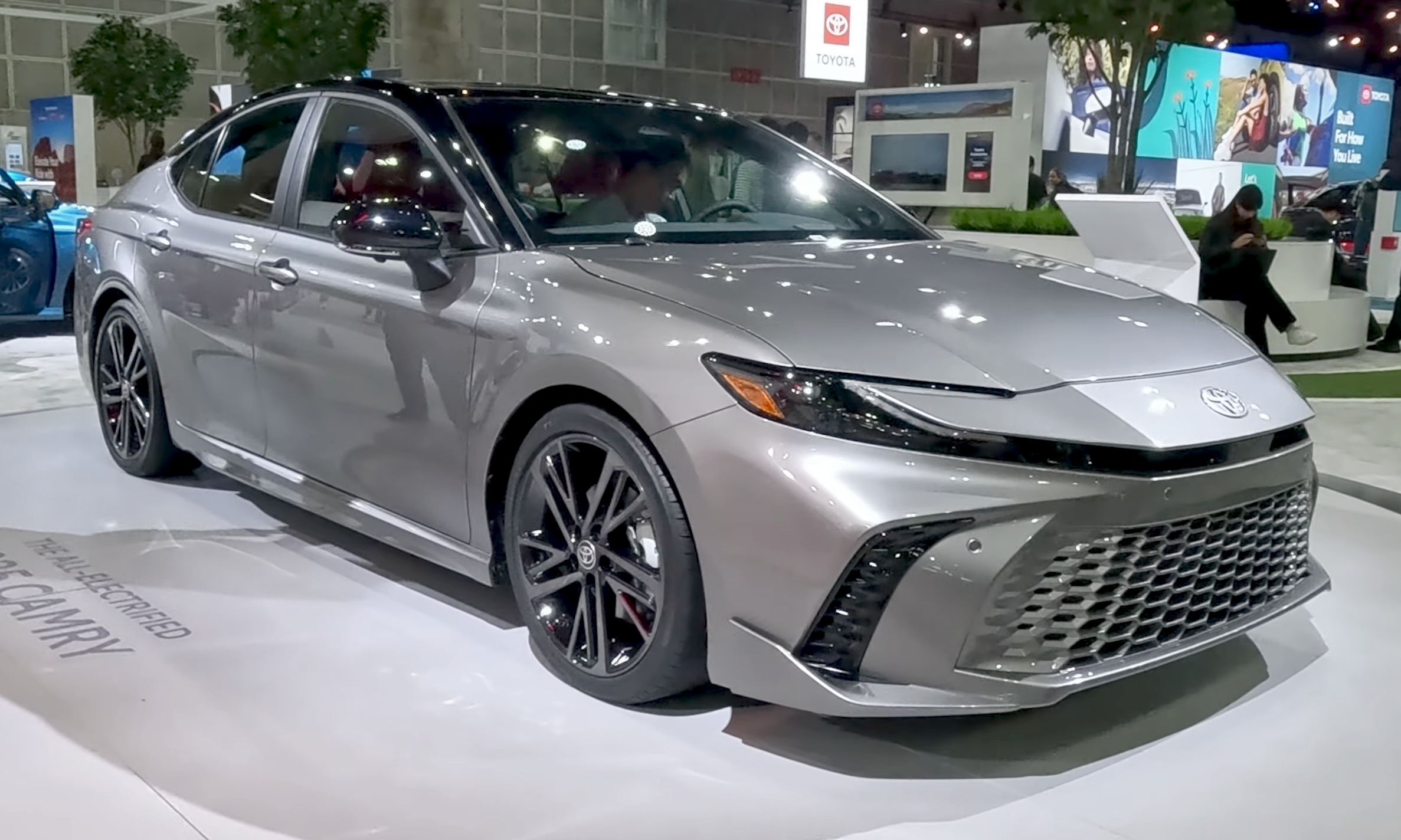
2025 Toyota Camry. Wikimedia Commons
Imagine the interior of a Toyota Camry.
Now place two above-average-sized adults in the rear seat with a teenage girl. Put two adult men in the front. Fill the trunk with luggage, then distribute whatever does not fit across the passengers’ laps.
Now remain that way for more than 12 hours.
Every stop became a small-scale evacuation. It took approximately 20 minutes to get everyone out, complete the stop, climb back inside, redistribute the bags, and settle into something resembling a survivable position.
The estimated arrival time on the GPS continued slipping farther into the night:
12:51 a.m.
1:20 a.m.
2:10 a.m.
3:15 a.m.
Our original plan had been to follow Route 66 through much of Illinois. Under the circumstances, that idea disappeared immediately. We were fortunate just to reach St. Louis before sunset.
South of St. Louis, we followed U.S. Route 67 toward Arkansas. Deer repeatedly appeared along the edges of the highway, poking their heads out of the trees and forcing us to reduce our speed further in case one decided to leap into the road.
Somehow, we continued making progress.
Then we reached Newport.
The Second Pothole

AI Generated image of Potholes in Arkansas.
Just south of Newport, the driver of our now-only car yawned.
At that precise moment, he failed to see a substantial pothole in the roadway.
We struck it directly.
The tire effectively exploded on impact.
We pulled onto the shoulder in northeastern Arkansas at approximately two in the morning.
Anyone familiar with the region knows that Arkansas’ unofficial state insect remains extremely active at that hour. By the time the tire was changed, we had collectively donated a significant quantity of blood to the local mosquito population.
We were finally moving again—but on a temporary spare tire.
That meant a maximum speed of roughly 55 mph.
For the final 90 miles.
We reached home at approximately 4:30 in the morning. The family member traveling with us did not arrive at her own home until around 5:00.
After a trip like that, most people would unload the car, close the garage door, and refuse to travel again for several months.
Unfortunately, we still owned another car.
And it was sitting in Chicago.
The Return to Chicago
The following Monday, we took the Camry to our local Toyota dealership to have the damaged tire replaced under its road-hazard warranty.
In keeping with the general theme of this trip, the dealership did not have the correct tire in stock. We were told a replacement might not arrive until Thursday—the same day we were tentatively planning to return to Chicago for the Corolla.
Fortunately, the tire arrived a day early. The Camry was repaired on Wednesday, and within minutes of leaving our local dealership, the phone rang.
The Corolla had been repaired and was ready to be collected.
Two of us climbed back into the Camry and began another 12-plus-hour journey north. This time, we followed Interstate 57, capturing the entire highway as it exists in 2026.

Begin Route 66 sign – Chicago, IL. © The Open Road Archive
Upon reaching Chicago, we went directly to the dealership and retrieved the repaired vehicle. From there, we split into two cars and began making our way south toward our hotel in Joliet.
Before leaving the city, however, we made a brief stop at the famous BEGIN ROUTE 66 sign. We drove the first mile or so of the historic highway, looped back toward Lake Shore Drive, and visited the northern terminus of Interstate 55.
We arrived in Joliet without incident, although the driver of the recently repaired car was understandably tense for much of the journey.
We ended the day with a visit to a restaurant we had not seen in approximately 40 years: Rax.
After everything that had happened, a quiet roast beef sandwich felt like a major victory.
Finally, the Mother Road

Route 66 sign in Normal, IL. © 2026 The Open Road Archive
The following morning, we left Joliet on historic Route 66 and began traveling south toward Springfield.
Along the way, we made brief stops in communities such as Pontiac and explored some of the roadside attractions, preserved signs, murals, museums, and automobile-era kitsch for which the Mother Road is famous.
In our opinion, much of Illinois Route 66 consists of long sections of frontage road punctuated by concentrated pockets of history. The road itself can occasionally feel repetitive, but the towns along it have done an admirable job of preserving the route’s identity and giving travelers reasons to stop.
In Springfield, we filmed the approach to Abraham Lincoln’s burial site and followed Route 66 into downtown, where we stopped to visit Lincoln’s home.
From there, we returned to Interstate 55 and continued south toward St. Louis before following U.S. Route 67 back into Arkansas.
We had considered filming Interstate 44 toward Springfield, Missouri, but we spent too much time exploring Route 66 to make that detour practical.
For once, changing the plan was not caused by weather, mechanical failure, road construction, insects, potholes, or an inability to reverse.
We were simply enjoying the road.
The Roads We Remember

Field of Giants. © The Open Road Archive
This was supposed to be one straightforward trip to Dayton, followed by a short visit to Chicago and a long drive home.
Instead, it became two journeys to Chicago, five people packed into one car, hours of torrential rain, a ruined camera view, two consequential potholes, a disabled vehicle, a holiday-weekend repair delay, an exploding tire, a roadside encounter with the entire mosquito population of Arkansas, and more than 24 additional hours of driving to retrieve the car we had left behind.
Clark Griswold would have been proud.
But somewhere inside the chaos, we captured new highways, completed Interstate 57, added major sections of Interstates 55, 65, 69, and 71 to the archive, drove the opening mile of Route 66, explored Chicago with family, revisited a restaurant from our past, and returned home with a story far more memorable than the journey we originally planned.
That is the strange bargain of road travel.
The perfect trip may give you beautiful footage and an easy ride, but the imperfect trip gives you the stories you continue telling years later. The delays, detours, breakdowns, weather, wrong turns, and roadside repairs become part of the road itself—permanent mile markers in our personal history.
We would not choose to repeat this particular adventure.
But we also would not erase it.
Because the RealRoads archive is not only a record of pavement, interchanges, cities, and landscapes. It is a record of what happened while we were out there: the places we reached, the problems we survived, and the roads that carried us home when nearly everything else went wrong.
Sometimes the journey goes exactly according to plan.
And sometimes the road gives you your own Griswold vacation.
Postscript: The Trip That Refused to End
At the time of this writing, we are still dealing with the consequences of this trip.
During the return drive to Chicago, we began hearing an unusual noise coming from the Camry’s tires. We assumed the newly installed tire simply needed some time to settle in.
But you know what they say about assumptions.
We learned this morning that the Newport pothole struck hard enough to knock the car severely out of alignment. The alignment had apparently already been slightly off following an earlier tire incident several months ago, and this latest impact made the problem considerably worse.
The sound we had been hearing was not a new tire breaking in. It was another tire being rapidly destroyed—and approaching the sort of failure nobody wants to experience while traveling at highway speed.
So, nearly 20 days after this entire fiasco began, the trip is technically over.
The repairs, however, are not.



0 Comments